At an IBJJF tournament, an inspector checks your gi before you weigh in, minutes before your first match. If your sleeves are too short or your patches are in the wrong place, you have to fix it on the spot. This guide explains what the inspector looks for, how the check works, and how other organizations' rules compare, so you can check your own gi at home days before.
Want to go through it step by step? Use the gi check tool: pick the organizer, then tick off each check as you measure.
Key takeaways
- IBJJF gis must be white, royal blue or black, with the jacket, pants and collar all one color.
- With your arm held straight out, the sleeve must end within 2 cm (about ¾ inch) of your wrist.
- Pants must reach within 2 cm of your ankle bone.
- The collar can be at most 1.3 cm thick and 5 cm wide.
- You get up to three tries at inspection, but you can't change gis after weighing in for your first match.
- Most other organizers are looser, but a gi that passes IBJJF's check will pass almost anywhere.
- Even where the rules say nothing, expect officials to check your nails, gi length, tears and patches.
When and how the gi check happens
IBJJF checks your uniform right before you weigh in, which happens just before your first match. An inspector looks at size, patch placement, cleanliness, your belt and the gi's overall condition, using a measuring gauge for the sleeves, pants, collar and belt.
You're allowed up to three inspections, so if something fails you can fix it and come back. But once you've weighed in, you can't switch to a different gi for your first match. If you change gis later in the day, the new one has to be inspected too. If you compete with braces or pads, wear them to the inspection.
What the inspector measures
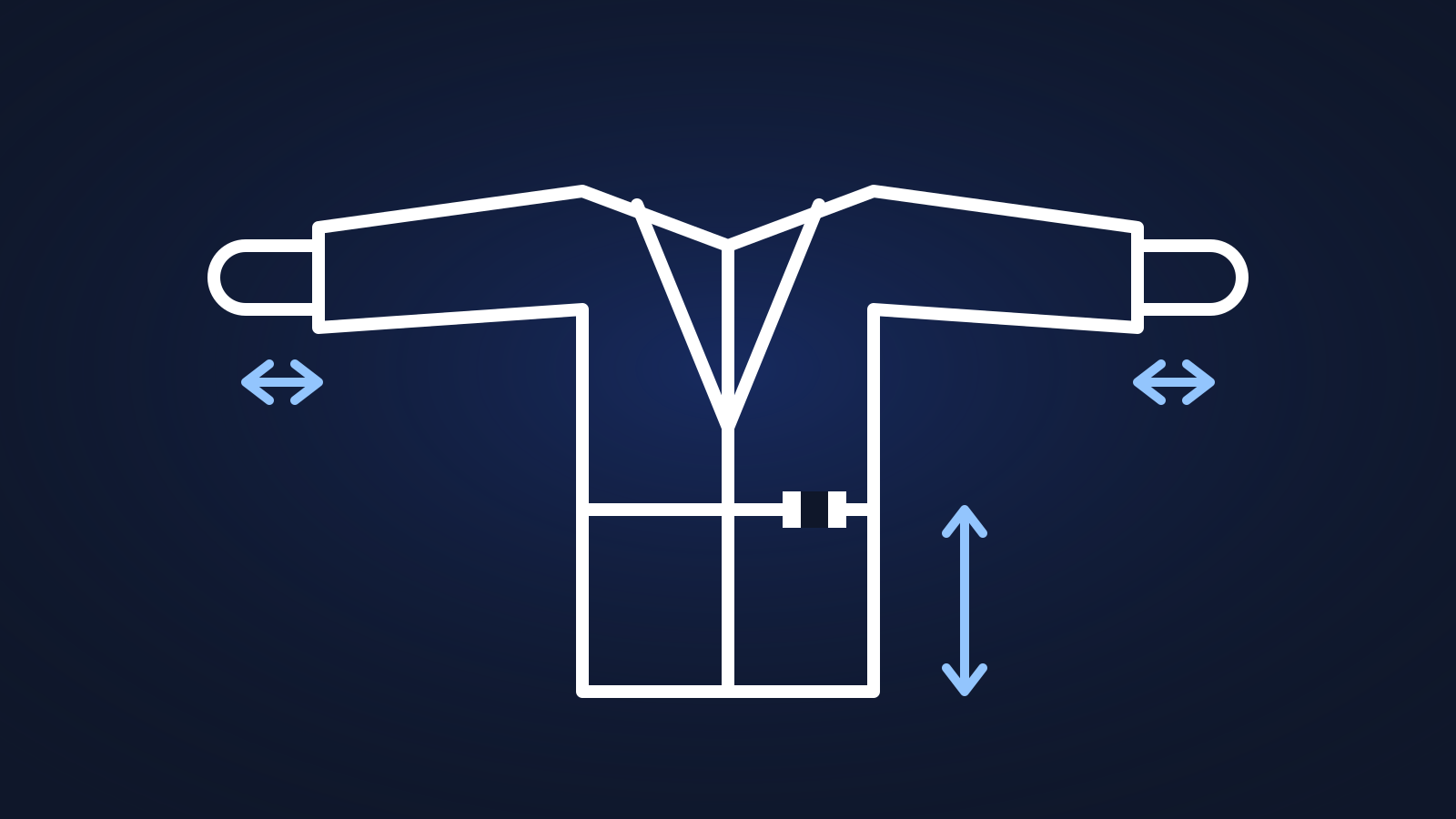
- Sleeves: with your arm straight out in front, parallel to the ground, the sleeve must end no more than 2 cm from your wrist. There must be at least 7 cm of room inside the sleeve along its whole length, so a tight, fitted sleeve can fail even if it's long enough.
- Pants: the hem must reach no more than 2 cm above your ankle bone, with at least 7 cm of room in the leg.
- Collar: at most 1.3 cm thick and 5 cm wide.
- Jacket: long enough to reach your thighs.
- Belt: 4 to 5 cm wide, wrapped around twice and tied in a double knot that keeps the jacket closed, with each end hanging 20 to 30 cm.
Cotton gis can shrink in the wash and dryer. A gi that fit perfectly when new can come up short a few washes later, so measure the gi you'll actually wear, not the size on the label.
Colors and fabric
The gi must be completely white, royal blue or black. The jacket and pants have to match, and the collar can't be a different color. Adult black belts can be asked to bring two gis, one white and one royal blue. For juvenile, adult and masters divisions the gi must be pearl weave, and no gi can be so thick or stiff that it's hard to grip.
Patches and painted gis
Patches must be cotton and sewn all the way down, and they can only go in the places shown in the drawing in IBJJF's rulebook. Inspectors remove patches that are loose or in the wrong place. Paint is only allowed as an academy or sponsor logo, in those same places. Nothing political or offensive is allowed on a gi.
Condition, and what you wear underneath
No tears or mended spots, and the gi must be clean, dry and odor-free. Men can't wear a shirt under the jacket or pants under the gi pants. Women must wear a close-fitting stretch shirt under the jacket (any color), or a one-piece swimsuit. Everyone must wear brief-type underwear.
Nails must be short and long hair tied up. Jewelry, hair pins, cups, shoes and hard braces aren't allowed, and neither are oils or creams.
IBJJF no-gi uniform rules
No-gi has its own uniform rules at IBJJF events. Your rash guard must be skin-tight, reach the waistband of your shorts, and be black, white, or black and white with at least 10% of your belt color. A shirt entirely in your belt color is also fine. Shorts must be black, white or your belt color, with no pockets, buttons, zippers, exposed drawstrings, plastic or metal, and must reach at least halfway down your thigh but no lower than your knee.
How other organizers compare
- NAGA: any color, even a mismatched top and pants. Sleeves and pants can end up to 1½ inches short. A cup (men) and a mouthpiece are required.
- Grappling Industries: any color, mismatched is fine, and no measurements, though officials can make you change a gi that's obviously too short or long.
- AGF: any color, but the top and pants must match. Sleeves within 1 inch of the wrist and pants within 2 inches of the ankle bone.
- JJWL: seven colors allowed (white, gray, blue, black, pink, purple, green), one solid color. Sleeves and pants within 5 cm, and you weigh in wearing your gi.
- NABJJF: black, white, royal blue or navy for juvenile and up; kids can wear any single color.
- FUJI BJJ (Brazilian Jiu-Jitsu): uses IBJJF's measurements.
Each organizer's full checklist is in the gi check tool, and the organizer comparison covers their other rules, from weigh-ins to guaranteed matches.
Basic checks at almost every tournament
Plenty of organizers don't write uniform rules down, and event pages rarely mention them. That doesn't mean anything goes. Officials at most tournaments still give every competitor a basic check, and can send you away to fix a problem before you compete:
- Fingernails and toenails: trimmed short and clean, on your hands and your feet. Many events look at both, often at weigh-in.
- Gi length: sleeves close to your wrists and pants close to your ankles. A gi that's clearly too short, often from shrinking in the dryer, can be turned away.
- Rips and tears: no holes or torn seams in the gi, belt, rash guard or shorts. A tear gives your opponent an extra grip.
- Patches: every patch sewn all the way around, with no loose edges or corners an opponent could grab. Officials can make you remove a loose patch, and extra patches added on top may not be allowed.
- Clean and dry: washed, fully dry and not smelly.
- Belt: your rank's belt, in one piece, without fraying ends or hanging threads.
- Jewelry and hair: all jewelry off, including rings and piercings, and long hair tied back.
The gi check tool adds these basics to every organizer's checklist wherever its own rules leave them out.
Check your gi at home
- Put on the gi you'll compete in, freshly washed and dried the way you normally do.
- Hold your arms straight out in front of you and have someone measure from each sleeve end to your wrist.
- Stand straight and measure from each pant hem to your ankle bone.
- Check that the jacket, pants and collar are one allowed color.
- Look over the patches: sewn down all the way, and only in allowed places.
- Check the knees, collar and sleeve ends for tears.
- Tie your belt and measure the hanging ends.
- Trim your fingernails and toenails, and take off any jewelry.
If you can, pack a second gi that passes too. It's cheap insurance against a failed check or a gi torn in an early match. For the rest of your packing and planning, see how to prepare for a BJJ tournament.
Rules can change, and each event can add its own, so always check the event page and the organizer's current rulebook before you go. Ready to pick your next event? Find tournaments near you.