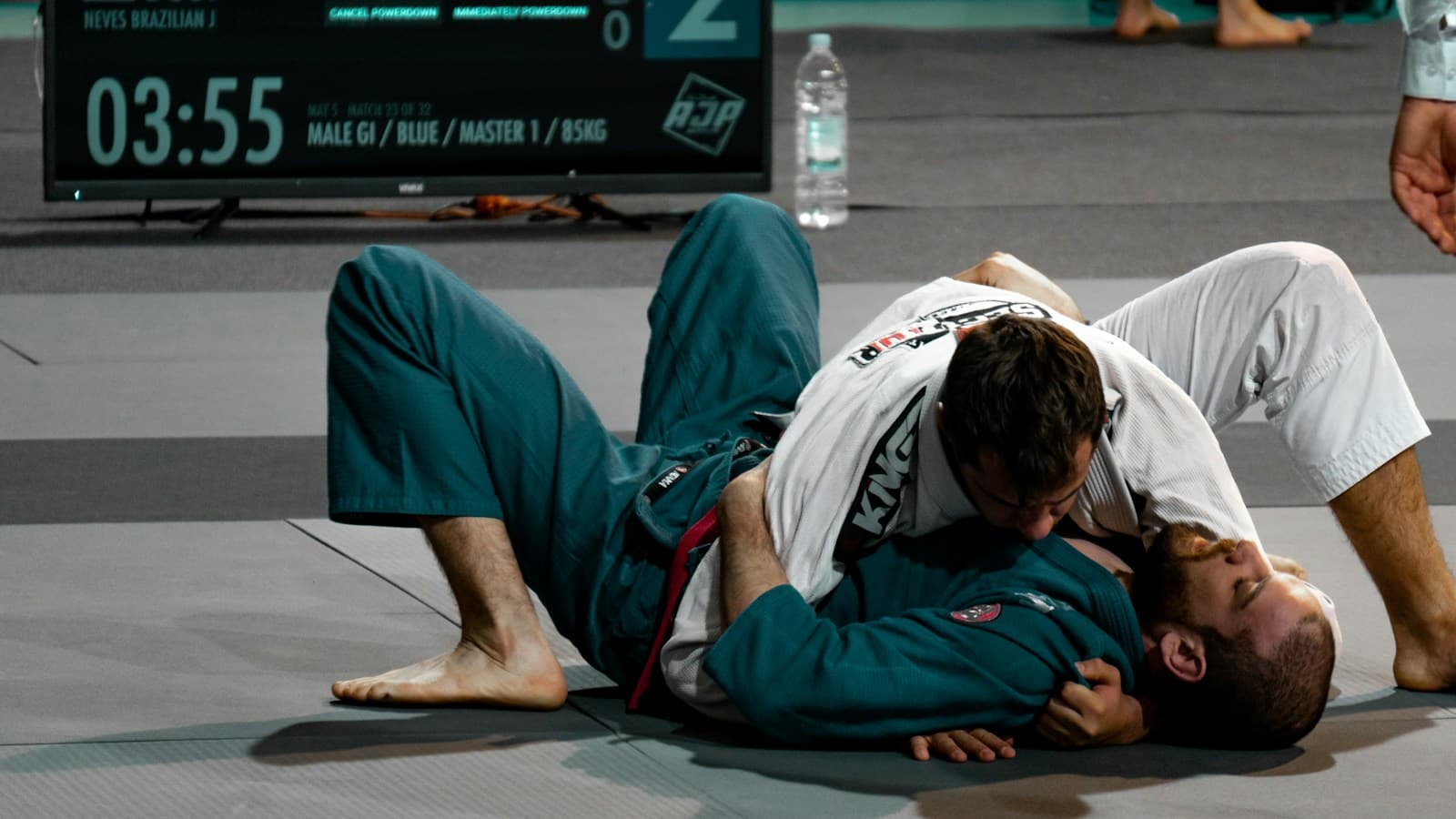
Most jiu-jitsu matches don't end in a submission. They end when the clock runs out and the referee raises the hand of whoever is ahead on the scoreboard. If you don't know how that scoreboard works, you can dominate a match and still lose it.
This guide explains how points are scored under IBJJF rules, which most gi tournaments in the United States follow or borrow from, plus how advantages, penalties and tiebreaks work, and where other organizations do it differently.
The point values
| Position | Points | What it takes |
|---|---|---|
| Takedown | 2 | Bring your opponent from standing to the mat and establish control on top |
| Sweep | 2 | Start in guard on the bottom and reverse the position so you end up on top |
| Knee on belly | 2 | From the top, put your knee on your opponent's stomach or chest with your other leg posted |
| Guard pass | 3 | Get past your opponent's legs and settle into side control or north-south |
| Mount | 4 | Sit on your opponent's torso with both knees on the mat |
| Back control | 4 | Get behind your opponent with both hooks in, your heels inside their thighs |
Hold it for three seconds
A position only scores once you control it for three seconds. Pass the guard and get swept back a second later, and you get nothing. The referee shows the points with their fingers after the count, so watch for it.
Points stack
Points add up as you move through positions. Sweep your opponent (2), pass their guard (3) and take the mount (4), and you've scored 9 points. That's why good competitors keep advancing instead of settling for the first position they reach.
What doesn't score
- A submission attempt that doesn't finish. A good attempt can earn an advantage, but no points.
- Pulling guard. Sitting to guard from standing is allowed, but it scores nothing.
- Reversing from the bottom of side control or mount. That's an escape, not a sweep, because you didn't start in guard.
- Back control with only one hook in, or holding the belt from behind.
Advantages
An advantage is a near-score. The referee awards one when you almost complete a scoring position, like a sweep your opponent stops at the last moment, or when a submission attempt puts your opponent in real danger. Advantages don't add to your points. They only matter if the points are tied.
Penalties
Referees penalize stalling, fleeing the mat, grabbing inside the sleeve or pants, and other rule breaks. Penalties can hand your opponent an advantage or points, and enough of them gets you disqualified. Some techniques get you disqualified on the first offense, like slamming or reaping the knee at the wrong belt level. Read the rulebook for your event, because the exact penalty steps differ between organizations.
How a tie is broken
When the clock runs out, the referee compares, in order:
- Points
- Advantages
- Penalties (fewer wins)
- The referee's decision, if everything is still even
That order is why the last 30 seconds matter so much. If you're up by one advantage, you don't need to take a risk. If you're down by one, you need to go get something.
How long a match lasts
Under IBJJF rules, adult matches run 5 minutes at white belt, 6 at blue, 7 at purple, 8 at brown and 10 at black. Masters and kids' matches are shorter. Other organizations set their own times, so check the event page.
Other rule sets score differently
- ADCC gives no points in the first half of a regulation match. Mount is worth 2 and back control 3, and pulling guard costs you a negative point.
- Submission-only events, like Submission Challenge, have no points at all. A match without a submission goes to overtime or a decision.
- Grappling Industries runs round-robin brackets, so you get several matches in a division.
- No-gi rules often change what's legal, especially leg locks. See gi vs. no-gi tournaments.
Play the scoreboard, not just your opponent
Know the score and the time at every reset. Ahead with a minute left, hold your position and stay safe. Behind, take smart risks, because a stalled match ends in a loss.
I've competed in and watched countless matches that were won in the last few seconds on points. The scoreboard is right there next to the mat, so everyone knows who's ahead. And when someone is ahead with a short time left, they tend to stall, because they know they'll win if they just hold on.
That's why scoring first is so big in a 5-minute match. It puts the other person behind, and now they're fighting both you and the clock. If you're the one behind, the pressure is on you to make something happen. Don't count on the referee to bail you out. Referees usually warn a staller first and only call a penalty if the stalling continues. If you're down by 4 points, a penalty or two against your opponent won't be enough to win.
So score first, and if you don't, push the pace. I've had matches go 0-0 through regulation and 0-0 through overtime, and I won on advantages because I kept attacking. At one tournament I pushed so hard I could barely stand up afterward. When the referee raised my hand, I could barely hold my arm up. My opponent played pure defense. He kept me from scoring, but in the eyes of the referee and everyone watching, he lost.
The scoring system isn't on your side when you're behind or the match is tied. Be the one who pushes.
New to competing? Start with how to pick your first BJJ tournament, then find a tournament near you.