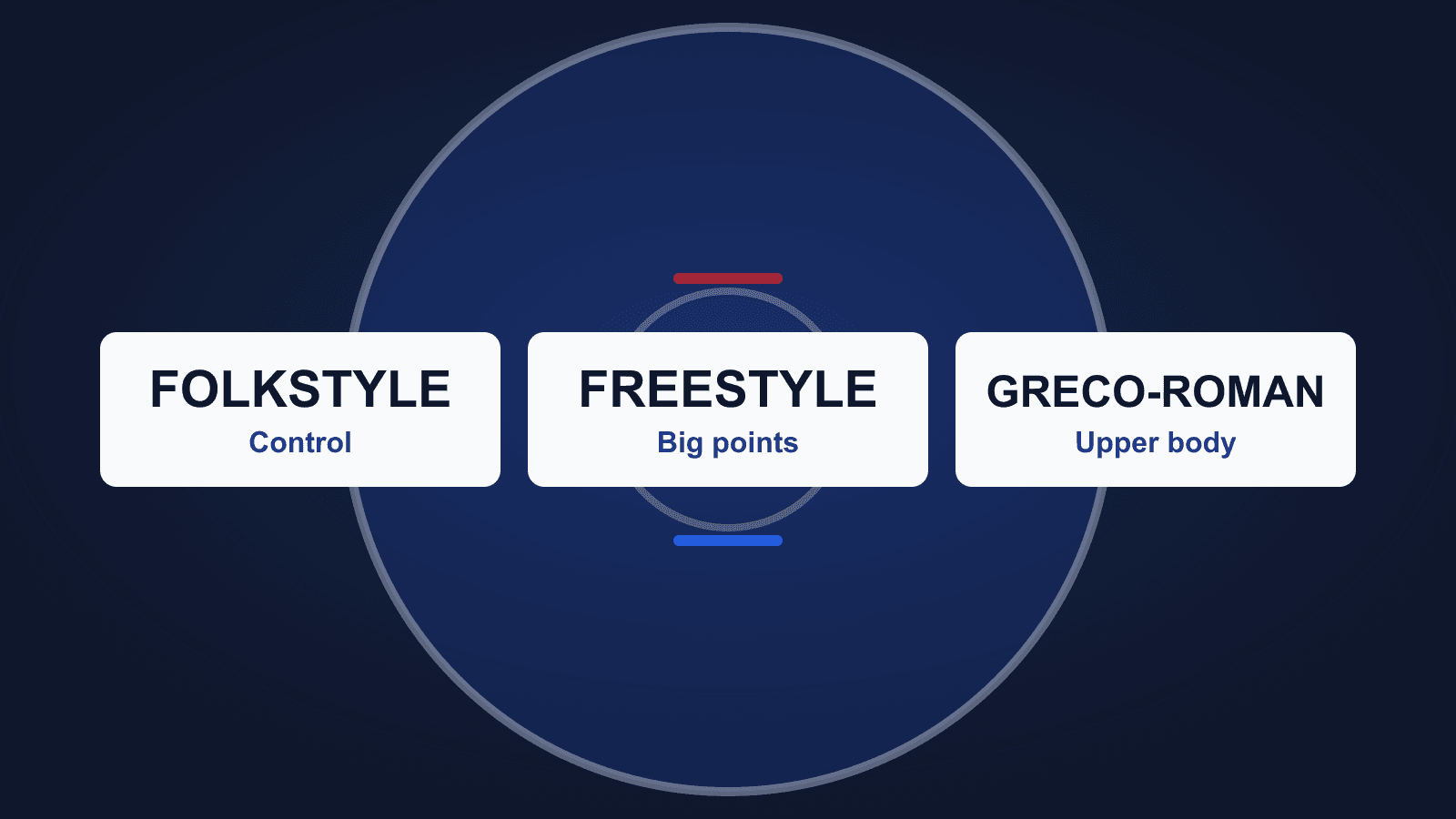
If you grew up in America, the wrestling you know is probably folkstyle. It's what high schools and colleges wrestle. But open the calendar in the spring and you'll see freestyle and Greco-Roman tournaments everywhere, and those are different games. Same singlet, same mat, different rules about what scores and what you can grab.
Here's how the three styles differ, and how to pick the right tournament.
At a glance
| Topic | Folkstyle | Freestyle | Greco-Roman |
|---|---|---|---|
| Where you see it | U.S. middle school, high school and college | Olympics, world championships, U.S. club events | Olympics, world championships, U.S. club events |
| Legs | Attack legs, trip, ride with your legs | Attack legs, trip, use your legs | No holds below the waist and no using your legs |
| What wins points | Control: takedowns, escapes, reversals, riding | Takedowns, exposures and big throws | Throws, lifts and exposures from the upper body |
| On the mat | Long periods of top and bottom wrestling | Short; turn your opponent fast or you're stood up | Short; starts from par terre after passivity |
| Takedown | 3 points | 2 points (4 or 5 for big throws) | 2 points (4 or 5 for big throws) |
| Pin | Shoulders held 2 seconds (1 in college) | Long enough for the referee to see control | Long enough for the referee to see control |
| Mercy rule | 15-point lead (technical fall) | 10-point lead (technical superiority) | 8-point lead (technical superiority) |
| Season | Winter, with the school season | Spring and summer | Spring and summer |
Folkstyle numbers are for high school (NFHS rules). Freestyle and Greco-Roman follow United World Wrestling's international rules, which USA Wrestling uses with some changes for kids. Rules change often, so check the rulebook for your event.
Folkstyle: the control game
Folkstyle is the American scholastic style. It rewards control. You score by taking your opponent down, but then the match moves to the mat, and that's where much of it is won or lost.
After the first period, wrestlers take turns choosing how the next period starts: on top, on bottom, or standing. The top wrestler tries to hold their opponent down and turn them to their back. The bottom wrestler tries to get away. Getting out from underneath and back to your feet is an escape, worth 1 point. Coming out from underneath and ending up in control is a reversal, worth 2.
In high school, a takedown is 3 points. Holding someone near their back scores a near fall, worth 2 to 4 points depending on how long you hold it. Hold both shoulders down for two seconds and it's a pin. Win by 15 and the match ends early in a technical fall. College adds riding time: the wrestler who spends at least a minute more on top over the match earns an extra point.
Folkstyle runs with the school season, roughly November through March. Youth clubs and USA Wrestling run folkstyle tournaments in the same months, and girls' high school wrestling uses folkstyle too.
Freestyle: the big-points game
Freestyle is wrestled at the Olympics by both men and women. You can still attack the legs, so a folkstyle wrestler's shots carry over. What changes is what the referee is looking for.
Freestyle doesn't reward holding someone down. It rewards exposure: turning your opponent's back toward the mat, even for a moment. A takedown is 2 points. Turning your opponent past 90 degrees, like with a gut wrench or a leg lace, is 2 more, and you can roll them again and again. A throw that takes someone from their feet straight to their back is worth 4, and a big, high throw that lands them in danger is worth 5. Pushing your opponent out of bounds with a foot earns 1 point.
If you can't turn your opponent quickly on the mat, the referee stands you both back up. There's no riding and no points for escaping. Folkstyle wrestlers often get caught here: they hold a tight ride, then lose 2 points rolling through a gut wrench they'd never see in a high school match.
Freestyle also punishes stalling with a shot clock. If the referee calls you passive, you have 30 seconds to score, or your opponent gets a point. A 10-point lead ends the match.
Greco-Roman: upper body only
Greco-Roman has the same scoring as freestyle with one huge difference: no holds below the waist. You can't grab the legs, trip, or use your own legs to lift or hold your opponent. Everything comes from the upper body: underhooks, body locks, arm drags, and the lifts and throws that make Greco highlight reels.
Because you can't shoot, standing matches are a lot of hand fighting and pummeling for position. When one wrestler is clearly more active, the referee calls the other passive. The active wrestler gets a point (for the first two passivity calls of a match) and chooses whether to keep wrestling standing or start in par terre, a top-and-bottom position on the mat where they can try to lift or turn their opponent. An 8-point lead ends the match.
At the Olympics, Greco-Roman is a men's event. Women wrestle freestyle.
Close matches
Folkstyle ties go to overtime. In freestyle and Greco-Roman there is no overtime: a tie is decided by who scored the biggest move, then the most big moves, then the fewest cautions, then the last point scored. That's why a 4-4 match can go to the wrestler who hit one 4-point throw over the wrestler who scored two takedowns.
Gear and weigh-ins
All three styles are wrestled in a singlet and wrestling shoes. Headgear is required in high school folkstyle. In USA Wrestling's freestyle and Greco-Roman events, it's recommended for young wrestlers and allowed for older ones. National-level freestyle and Greco events may also want a red or blue singlet, while folkstyle singlets can be any colors.
Weight classes differ between styles and organizations, so don't assume your school weight carries over. Check the USA Wrestling weight classes for club events, and read how to make weight before you cut.
Which should you enter?
If you or your child wrestle in school, start with folkstyle. It's what you practice, and it's where a youth season builds toward.
When the school season ends, try freestyle. It's the easiest jump from folkstyle because your shots still work. Expect to give up some points to exposures at first, and expect to learn a lot about keeping your back off the mat. That lesson makes you better in folkstyle too.
Try Greco-Roman when you want to sharpen your upper body. Even wrestlers who never plan to specialize in it come back with better hand fighting, better body locks, and less fear of being thrown.
Many tournaments in the spring and summer offer freestyle and Greco-Roman on the same weekend, so you can enter both. Filter the calendar for folkstyle, freestyle or Greco-Roman tournaments near you.