A judo match can end in a few seconds. Throw your opponent cleanly onto their back and the match is over, no matter what the clock says. That one idea, the ippon, shapes everything else in the rules: how throws are scored, how hold-downs count, and why the penalties push both players to keep attacking.
This guide explains the international (IJF) rules that USA Judo and most US tournaments follow, plus the changes US events make for kids and beginners.
Key takeaways
- There are three scores: ippon, waza-ari and yuko. An ippon ends the match on the spot.
- Two waza-ari make an ippon. Yuko are counted but never add up to a waza-ari.
- A hold-down scores yuko at 5 seconds, waza-ari at 10 and ippon at 20.
- A tap (twice or more) to a choke or armlock is ippon.
- Tied at the end? Golden score: no time limit, and the first score of any kind wins.
- Penalties never count as points. A third shido is hansoku-make, which loses the match.
- Grabbing the legs is a shido. Diving head first onto the mat loses the match on the spot.
How a match works
Players bow onto the mat, then the referee starts the match with "Hajime!" (begin). "Mate!" (wait) stops the action, for example when the players go out of bounds or stall on the ground, and both players return to their feet. "Sore-made!" means the match is over.
At international events one player wears a white judogi and the other a blue one. At local US tournaments a white judogi is the safe choice; some ask brown and black belts to bring a blue one too. Adult black belt matches last 4 minutes. Local events often run shorter matches for kids and beginners, such as 2 minutes for ages 5 to 8 and 3 minutes for older kids and adults below brown belt. The clock stops every time the referee calls "Mate!"
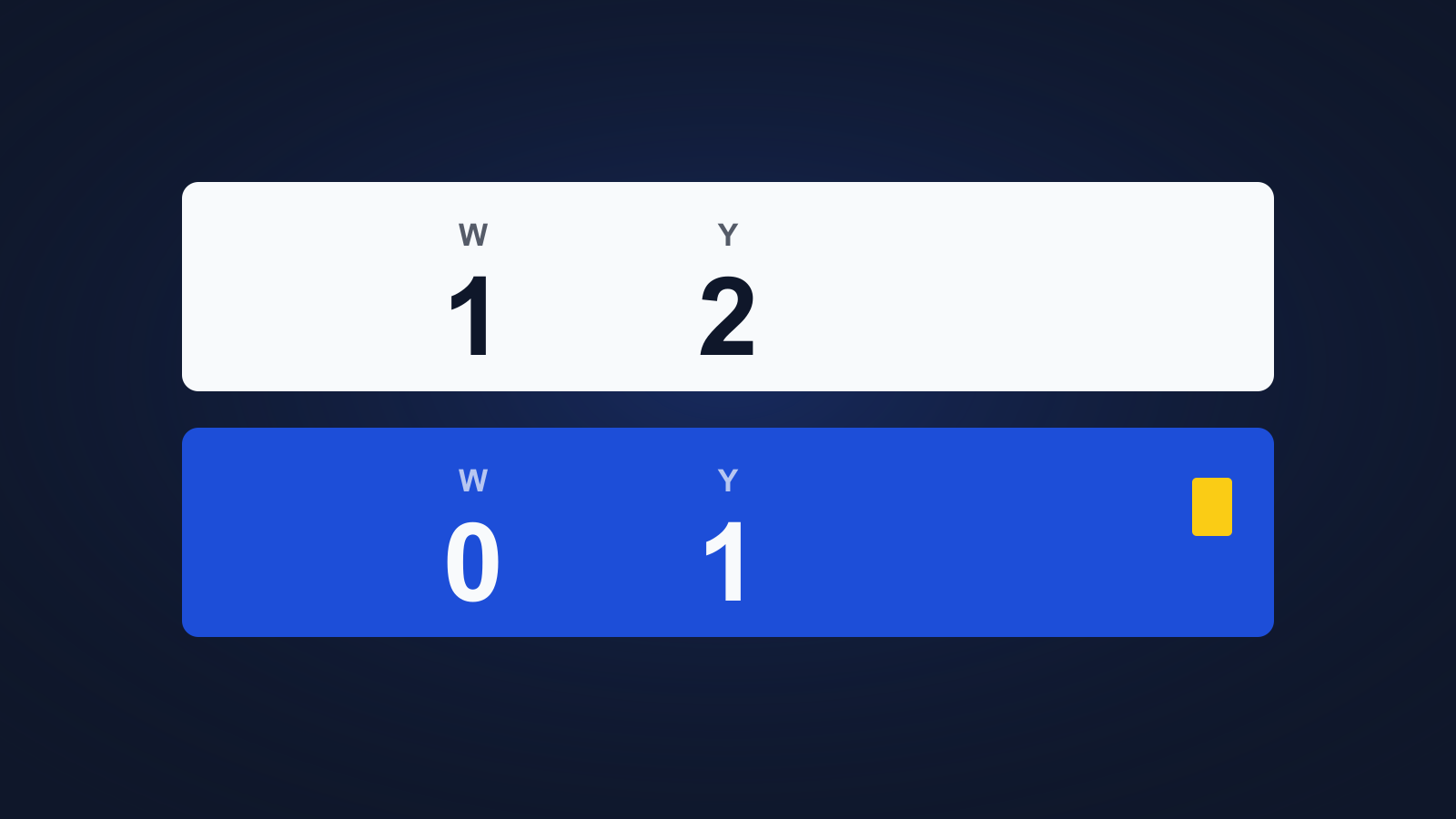
The three scores
| Score | From a throw | From a hold-down | What it does |
|---|---|---|---|
| Ippon | Your opponent lands on their back, thrown with speed, force and control to the end | 20 seconds | Wins the match immediately |
| Waza-ari | A landing that rolls past the side toward the back, but not flat on it | 10 to 19 seconds | Two waza-ari make an ippon |
| Yuko | A landing on the side, the upper back, or both buttocks leaning back | 5 to 9 seconds | Counted, but any number of yuko is still less than one waza-ari |
A throw must be a real judo technique. Rolling or falling over together during a scramble doesn't score. Landing on your knees or your stomach doesn't score either, which is why players twist out of throws to land face down. One safety rule surprises beginners: if you bridge on your head to avoid landing on your back, the referee gives your opponent ippon.
Yuko came back in the 2025 rules after being dropped in 2017, so older videos and coaching advice may not mention it.
Groundwork: pins, chokes and armlocks
When a throw doesn't finish the match, players can follow it to the ground (ne-waza). There are three ways to win there:
- Hold-downs (osaekomi). The referee calls "Osaekomi!" when you control your opponent on their back with a recognized pin, such as a scarf hold or side hold. Points come from the time you keep it, as in the table above. Holding someone between your legs, as in a BJJ (Brazilian Jiu-Jitsu) closed guard, isn't a pin.
- Chokes (shime-waza). Your opponent taps twice or says "Maitta!" (I give up), and you win by ippon.
- Armlocks (kansetsu-waza). Only the elbow can be attacked. Wrist locks, shoulder locks and every leg lock are illegal.
Groundwork has to keep moving. If neither player is making progress, the referee calls "Mate!" and stands you both up. That's why judo players turtle (face down on knees and elbows) so often: it's a safe position to wait in until the referee restarts the match standing.
How the winner is decided
If nobody scores ippon, the scoreboard is compared when time runs out:
- More waza-ari wins.
- If waza-ari are equal, more yuko wins.
- If the scores are equal, including 0 to 0, the match goes to golden score.
Penalties don't enter that list. Two shido against your opponent won't win you the match; only a third one will, because it's a disqualification.
Golden score
Golden score starts right away, with no rest, and has no time limit. Scores and shido from regular time stay on the board. The first player to score anything (yuko, waza-ari or ippon) wins. A hold-down that starts in golden score ends the match as soon as it reaches 5 seconds. You can also lose in golden score by picking up your third shido.
Penalties: shido and hansoku-make
A shido is a minor penalty. You can take two; the third is hansoku-make (disqualification) and loses the match. Common shido include:
- Not attacking enough (passivity), or making fake attacks with no real chance of throwing.
- Holding a standard grip for 30 seconds without attacking.
- Grabbing, hooking or touching the legs below the top of the inner thigh. This is the rule that catches most wrestlers and BJJ players.
- Stepping or running out of bounds on purpose, when you aren't attacking.
- A bear hug with your hands clasped together around your opponent.
- Breaking your opponent's grip with both hands, or gripping inside their pant leg while standing.
Hansoku-make can also be given straight away for dangerous moves. Diving head first onto the mat while throwing (for example in uchi-mata or seoi-nage) is one. So is falling straight to the mat with an armlock your opponent can't escape. Some moves are banned outright, such as kani-basami (the scissor takedown) and kawazu-gake (wrapping your leg around your opponent's and falling back into them). A hansoku-make for an act against the spirit of judo also removes you from the rest of the tournament.
Kids' and novice rules in the US
The IJF rules are written for cadets (under 18) and up, and leave younger age groups to each country. US events add their own limits, and they vary, so read the event page. Typical rules:
- Chokes are usually allowed from the 13-year-old divisions up, but not in novice divisions.
- Armlocks are often limited to older, experienced players. Some events allow them only in adult brown and black belt divisions.
- Using the head to throw or to defend is a hansoku-make in USA Judo divisions below cadets and in every novice division. Reverse seoi-nage, with the arm hooked backward under the opponent's armpit, is a shido there.
- Drop-knee throws, such as dropping to both knees for seoi-nage, are banned for kids under 13 at some events, such as USJF-sanctioned tournaments.
If you're a parent, ask your child's coach which division and rules they'll compete under, and see the kids tournament fit guide for picking a good first event.
Before you compete
- Check which rules the event uses, especially for kids and novice divisions.
- Drill your break-falls. You will get thrown, and a good fall keeps you safe.
- Practice gripping and attacking early, so you don't pile up shido for passivity.
- Find your weight class in the USA Judo weight class guide, and plan your weigh-in with how to make weight.
Ready to try it? Find a judo tournament near you.