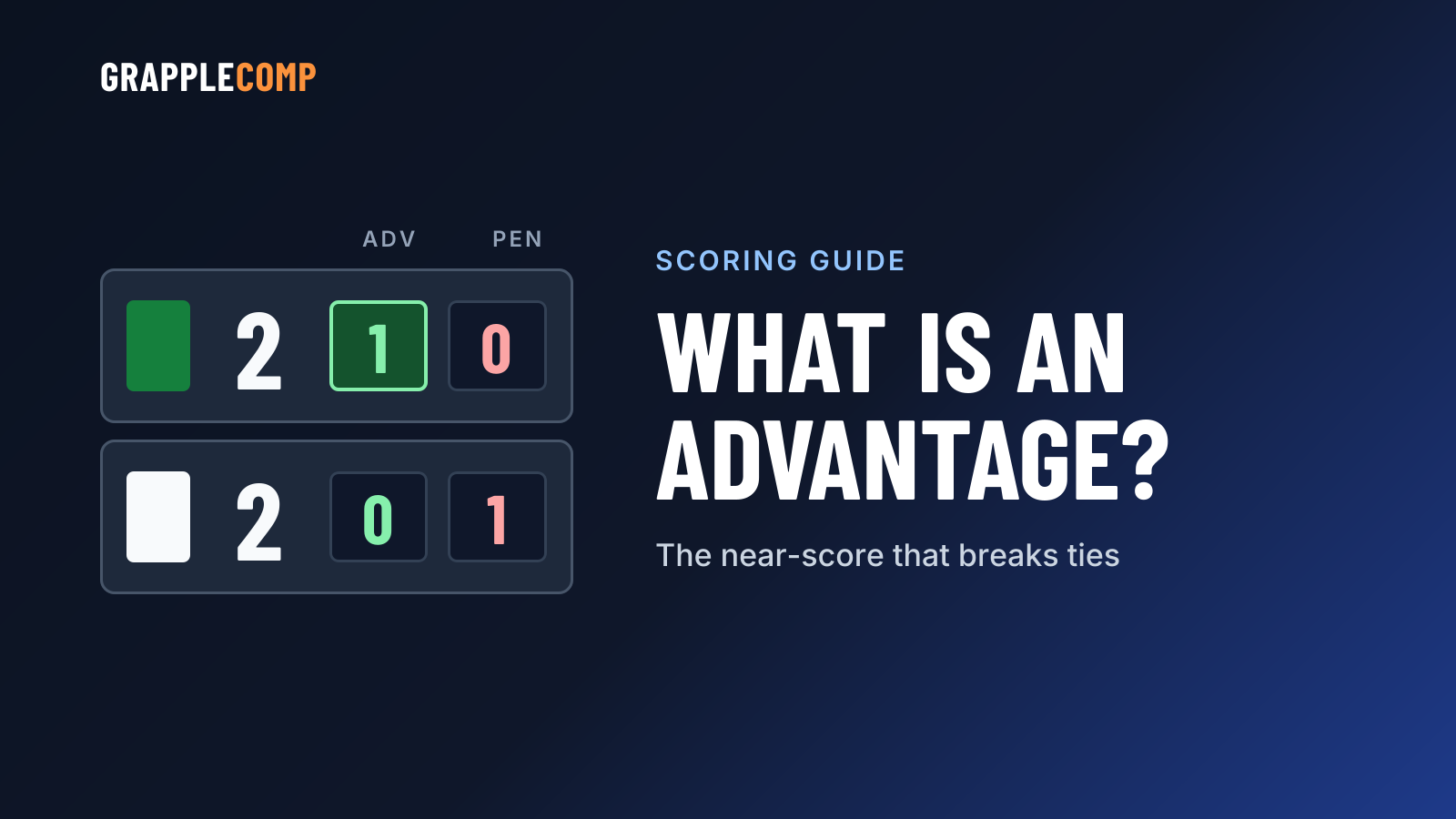
Two competitors finish tied on points. The referee raises one hand, and half the crowd looks confused. Nine times out of ten, the answer is on the scoreboard in the small column next to the score: the winner had one more advantage.
An advantage is a near-score in BJJ (Brazilian Jiu-Jitsu) competition. It's worth less than any point, but in a close match it's often the thing that decides who wins. Here's exactly when referees give one, when they don't, and how to use them.
Key takeaways
- An advantage is given for almost scoring or almost submitting your opponent.
- Advantages don't add to your points. They only matter if the points are tied.
- Any number of advantages is worth less than one point.
- Tied matches are decided by points, then advantages, then fewer penalties, then the referee.
- Your opponent's second penalty also gives you an advantage.
- Grappling Industries, AGF, ADCC and NAGA no-gi don't use advantages at all.
What earns an advantage
IBJJF's rule book, which most gi tournaments follow, gives an advantage in three main cases:
- You reach a scoring position but can't hold it. Positions only score after 3 seconds of control. Get there and lose it at two seconds, and you get an advantage instead.
- You nearly reach a scoring position. You get most of the way through a pass or sweep, and your opponent is in real danger of giving up the points, but they recover.
- You nearly submit your opponent. The submission has to put them in real danger of tapping. Grabbing an arm or throwing up a loose triangle they easily pull out of doesn't count.
The referee waits until there's no longer a chance of you completing the position before giving the advantage. So if you're still working toward the pass, you won't see it yet.
Common examples
The rule book lists examples. These are the ones you'll see most:
- A takedown where your opponent lands but bounces straight back up before 3 seconds
- A sweep that brings you on top, but your opponent recovers guard before 3 seconds
- A guard pass that gets you to half guard, or stacks your opponent, without finishing the pass
- Knee on belly with your other knee on the mat instead of your foot
- Mount on top of both of your opponent's arms, or back control with only one hook
- An armbar, choke or leg lock that nearly finishes before your opponent escapes
Other ways to get one
- Your opponent's second penalty. Under IBJJF rules the first penalty costs nothing, the second gives you an advantage, the third gives you 2 points, and the fourth disqualifies them.
- Coming up first when you both pull guard. If both competitors sit to guard at once, the first to get on top gets an advantage.
- A takedown that gets swept straight away. You get an advantage for the takedown, and your opponent gets 2 points for the sweep.
- Reaching positions while caught in a submission. If your opponent has you in a hold, positions you reach don't score until you escape, but each one can earn an advantage.
- A submission attempt that ends out of bounds. The referee may give an advantage.
When you don't get one
The rule book also lists near-misses that don't count:
- Reaching half guard on the way to a completed pass (you get the 3 points instead)
- Rolling on top after your opponent has taken you down
- Sweeps that start and end in 50/50 guard
- Giving up the top position on purpose after a sweep
- Dragging your opponent off the mat with a single leg, or a sweep that sends them out before you land on top
- A takedown that starts after your opponent has already started pulling guard
How advantages decide a match
When time runs out, the referee compares, in order:
- Points
- Advantages
- Penalties (fewer wins)
- The referee's decision, for whoever attacked more
Advantages never turn into points. A competitor with 2 points and no advantages beats one with 0 points and five advantages. NAGA's rule book puts it neatly: one point is worth more than any number of advantages.
The referee can still give an advantage after the clock runs out, as long as the result hasn't been announced. So a deep submission attempt in the last second can win a tied match.
How to spot one
The referee holds one arm out flat, parallel to the mat, with the hand open and palm down, pointing toward the competitor who earned it. On the scoreboard, advantages sit in their own column next to the score, usually in green, with penalties in red beside them.
Which organizers use advantages?
| Organizer | Advantages? | Instead |
|---|---|---|
| IBJJF | Yes | Tiebreaker after points |
| NAGA gi | Yes | Same as IBJJF |
| NAGA no-gi | No | Submission attempts score 1 or 2 points |
| Grappling Industries | No | Ties go to fewer penalties, then the referee |
| AGF | No | A strong submission attack scores 1 point |
| ADCC | No | Negative points for pulling guard and stalling; overtime if tied |
| AJP (UAE) | Yes | Counted as 1 point each, like penalties |
Most smaller gi tournaments that follow "IBJJF rules" use advantages too. If you're not sure, check the event's rules page. Our organizer comparison and ADCC rules guide explain the alternatives.
Using advantages in your matches
- Keep attacking. Every real submission attempt and every near-pass is a chance at an advantage. Competitors who keep moving forward win most tied matches.
- Make attempts count. A submission only earns an advantage if it's a real danger. Commit to it rather than throwing quick fakes.
- Know the score late in the match. If you're up by one advantage with 20 seconds left, you don't need to take a big risk. If you're down by one, you need a scramble, a near-pass or a submission threat, not necessarily the full points.
- Avoid the second penalty. It hands your opponent an advantage for free. Stalling, pulling guard without a grip and running out of bounds are the usual culprits.
For the full scoring picture, read how points are scored in BJJ and the IBJJF rules guide. Then put it to work at your next event: find one on the tournament calendar.