IBJJF runs the biggest jiu-jitsu tournaments in the world, and its rule book is the one most other gi tournaments copy. But the full book runs to more than 50 pages, and most competitors never read it. They learn the rules the hard way, from a penalty they didn't see coming or a match they lost on advantages.
This guide covers the rules that decide matches, in the order you'll meet them on competition day: your division, the gi check and weigh-in, how you win, how points and advantages work, what gets you penalized, and what gets you disqualified on the spot.
Key takeaways
- Your age division is set by your birth year, not your birthday. Adults are 18 and up; masters start at 30.
- Adult matches last 5 minutes at white belt and grow to 10 minutes at black belt. Most masters matches are 5.
- You weigh in once, in your gi, right before your first match. Miss weight and you're out.
- Positions score only after you hold them for 3 seconds.
- A tie goes to advantages, then fewer penalties, then the referee's decision.
- Your first penalty costs nothing. The second gives your opponent an advantage, the third gives them 2 points, and the fourth disqualifies you.
- Some fouls disqualify you instantly, including an illegal technique for your division, a slam, or running from a submission.
- Claiming a cramp ends the match, and you lose.
- New rules start on January 1, 2027: jumping guard becomes a disqualification for white belts and kids, straight foot locks become illegal for juveniles and white belts, and masters get a Master 8 division. See what changes in 2027.
Which rule book applies
These rules come from IBJJF's Rule Book, version 6.1, published in June 2024, along with the update guide that took effect on January 1, 2024. Both are free on IBJJF's website. Each event also publishes its own guidelines, and the rule book says those overrule it where they differ, so read the event page too.
IBJJF has also published a list of changes that take effect on January 1, 2027. They are summed up in their own section below and noted where they change a rule in this guide.
Plenty of organizers outside IBJJF say they use "IBJJF rules" or "modified IBJJF rules." If you're competing at one of those, this guide is a good start, but check their rule page for the differences.
Age divisions and match times
IBJJF counts your age as the current year minus your birth year. If you were born in 1996, you're a Master 1 (30 and over) for every tournament in 2026, even before your birthday. There's no upper age limit, so a 45-year-old can choose to compete as an adult.
| Division | Age that year | Match length |
|---|---|---|
| Mighty Mite | 4 to 6 | 2 minutes |
| Pee Wee | 7 to 9 | 3 minutes |
| Junior | 10 to 12 | 4 minutes |
| Teen | 13 to 15 | 4 minutes |
| Juvenile | 16 and 17 | 5 minutes |
| Adult | 18 and up | White 5, blue 6, purple 7, brown 8, black 10 minutes |
| Master 1 | 30 and up | White and blue 5, purple, brown and black 6 minutes |
| Masters 2 to 7 | 36, 41, 46, 51, 56 and 61 and up | 5 minutes |
| Master 8 (from 2027) | 66 and up | 4 minutes |
From January 1, 2027, Master 7 covers 61 to 65 and the new Master 8 covers 66 and up. Our IBJJF age divisions guide covers every division in detail, including who can compete in a younger one.
You get at least as much rest between matches as the length of your match, and double that before a final. Each division also has weight classes; see the IBJJF weight class guide for the limits.
One rule for new competitors: you can't enter as a white belt if you're a judo black belt, have fought MMA (amateur or pro), or have wrestled at a high level. In the United States, that means college wrestling or above.
Before your match: gi check and weigh-in
When your division is called, a ring coordinator checks your ID, sends you to the uniform inspector, and then weighs you. The order matters:
- Gi check first. The inspector measures your sleeves, pants and collar and checks your patches and belt. You get three tries to pass. Wear any knee or elbow brace for the inspection, even though you can take it off to weigh in. Our IBJJF gi check guide covers every measurement.
- One weigh-in, in your gi. You step on the official scale once, wearing the uniform you will compete in, right before your first match. There is no second try. Some events put a practice scale in the warm-up area; if yours does, use it.
- No gi swaps. After you weigh in, you can't change gis before your first match, or you're disqualified. After that, you can ask to switch, and the new gi gets inspected.
Over the limit means you're out of the division. Plan your weight with the uniform included; see how to make weight.
A few more rules catch people at the mat: nails must be short, long hair tied up, and no jewelry, cups, shoes or hard braces. Brief-style underwear is required in gi and no-gi, and a referee who finds you without it will disqualify you. Oils and creams on your skin get you disqualified too. Off the mat, keep your shoes on in the competition area.
How you win a match
The rule book lists every way a match can end:
- Submission. Your opponent taps twice with a hand (on you, the mat or themselves), taps twice with a foot if their arms are trapped, says they quit, or cries out in pain while caught in a hold.
- Stoppage. The referee stops a hold that could cause serious injury, or the doctor stops the match because of an injury from a legal technique. The match also ends if bleeding can't be controlled after two visits from the doctor, if a competitor vomits or loses bladder or bowel control, or if a competitor says they have a cramp. In each case, the other competitor wins.
- Disqualification for a foul (more on those below).
- Loss of consciousness from a legal hold or an accident.
- Points when time runs out.
- Referee decision when points, advantages and penalties are all tied.
- Random draw, only when both competitors are hurt in a tied final and neither can continue.
The cramp rule surprises people. If your calf locks up and you tell the referee, the match is over and you lose, so think twice before you say it.
Scoring: points and the 3-second rule
| Points | Positions |
|---|---|
| 2 | Takedown, sweep, knee on belly |
| 3 | Guard pass |
| 4 | Mount, back mount, back control |
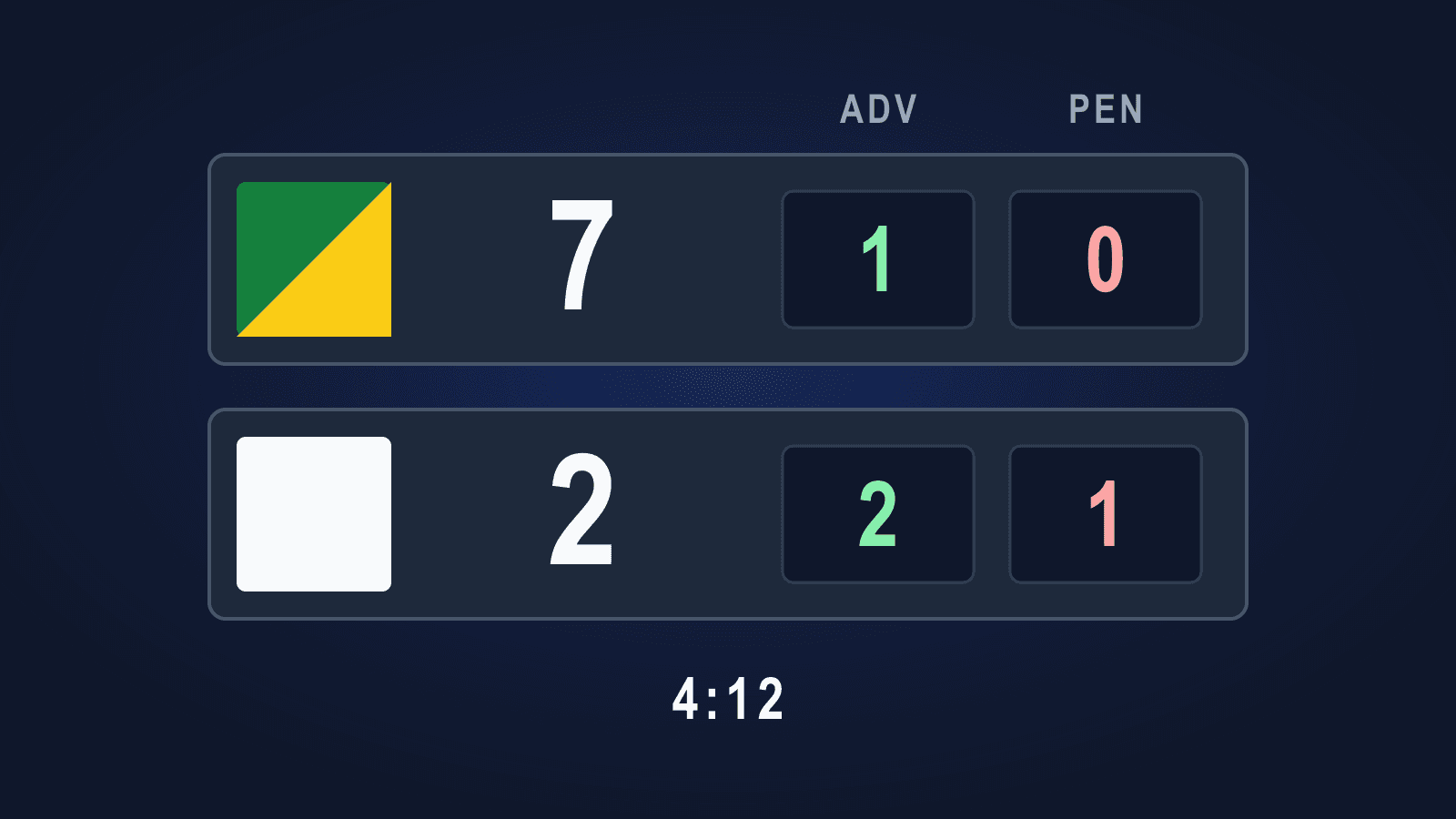
Every position has to be held for 3 seconds before it scores. Points add up as you move through positions without losing control: pass the guard and go straight to mount and you score 7. Our guide to BJJ (Brazilian Jiu-Jitsu) scoring explains what each position takes. A few IBJJF details that guide doesn't cover:
- No points while you're caught. If you reach a scoring position while your opponent has you in a submission, you get the points only after you escape and hold the position for 3 seconds.
- No points twice for the same thing. Give up a position on purpose to score it again, and the second time doesn't count.
- Escaping a submission off the mat costs 2 points. If you defend a submission by moving off the mat (past the safety area around the match area), your opponent gets 2 points. If the referee decides you ran out on purpose to escape the hold, you're disqualified.
- A submission near the edge keeps going. The referee doesn't stop the match while a submission is locked in, even in the safety area around the mat.
Guard pulling and takedowns
Pulling guard is legal and scores nothing, but you need a grip on your opponent first. Sitting or pulling guard without a grip is a penalty. A few more rules decide who scores when one person shoots and the other pulls:
- If your takedown starts before your opponent starts pulling guard, it can score. If it starts after, it can't.
- If you have a grip on your opponent's pants when they pull guard, you get 2 points for the takedown once you hold the top position for 3 seconds.
- If both competitors pull guard at the same time, the first one to come up on top gets an advantage. If neither gets on top within 20 seconds, both get a penalty and the match restarts standing. Until the end of 2026, the referee lets it go on if a submission is locked in or a score is about to happen; from 2027 the match is stopped regardless.
- Jumping to closed guard (including flying triangles and armbars) is illegal for every white belt and for everyone under 15. Until the end of 2026, the referee stands you both up, and if you did it to stop a takedown or sweep your opponent gets 2 points. From January 1, 2027, it's an instant disqualification.
- If your opponent jumps to closed guard while you hold their pants and they hang in the air, you need to bring them down onto their back, side or seat for the takedown. Until the end of 2026 you have 3 seconds to do it; the 2027 rules drop that time limit.
Advantages
An advantage is a near-score. The referee gives one when you almost finish a scoring position but can't hold it for 3 seconds, or when a submission puts your opponent in real danger of tapping. A submission that never threatens doesn't count. Advantages don't add to your points; they only matter in a tie. The referee can award one after the clock runs out, as long as the result hasn't been announced yet.
Penalties
Most fouls are what IBJJF calls serious fouls, and they climb a four-step ladder. Stalling penalties and foul penalties all count on the same ladder:
| Penalty | What happens |
|---|---|
| 1st | Marked on the scoreboard, nothing else |
| 2nd | Your opponent gets an advantage |
| 3rd | Your opponent gets 2 points |
| 4th | You're disqualified |
Kids under 15 get more room: the 4th and 5th penalties each give the opponent 2 points, and only the 6th is a disqualification.
Stalling
Stalling means not trying to improve your position. When the referee sees it, they count 20 seconds, then call "Lute!" and point at you, which is a penalty. Holding someone in closed guard without attacking, sitting in side control without trying to advance, and holding the belt to block a takedown are all examples. You can't be called for stalling while defending from under mount, back control, side control or north-south. And since 2024, if you hold a lapel or the belt in 50/50 guard, you have 20 seconds to make progress before you're penalized. From 2027 the same applies when you hold a lapel or the belt and wrap your leg around it to control your opponent: make progress within 20 seconds or take a penalty.
Common fouls
- Putting your fingers inside your opponent's sleeve or pant leg, or grabbing the inside of their gi
- Pulling guard or sitting down without a grip
- Running out of the match area to avoid a fight, or pushing your opponent out with no attack
- Running out to avoid a worse position or your opponent's score. This one also gives your opponent 2 points.
- Standing up from the ground to get away and not going back down
- Putting a hand or foot on your opponent's face, or a foot in their belt
- Putting a foot in the lapel without a hand grip, or in the collar behind the neck
- Taking more than 20 seconds to fix your gi or belt
- In no-gi, grabbing your opponent's clothes or your own
- Arguing with the referee, ignoring an instruction, or walking off before the result is announced
- Showboating before your hand is raised
Instant disqualification
Severe fouls skip the ladder and end your match on the spot:
- Using a technique that's illegal for your division, such as a heel hook at purple belt or a slam at any belt. See illegal techniques by belt or check your division in the What's legal at my belt? tool.
- A suplex that drives your opponent's head or neck into the mat
- Running out of the area to escape a submission
- Choking with your hands around the neck without using the gi, or pressing the windpipe with your thumb
- Covering your opponent's nose and mouth with your hand
- Reaping the knee where it's illegal, as defined in the rule book
- Oils, creams or anything that makes you or your gi slippery or sticky
- A torn gi you can't replace in the time the referee gives you
- Trying to get your opponent disqualified by putting yourself in an illegal position
- From January 1, 2027: jumping to closed guard as a white belt or in a division under 15
Behavior fouls are even more serious. Biting, striking, pulling hair, cursing, obscene gestures or hostility toward anyone, including the crowd, disqualifies you from the whole event. If you're also signed up for no-gi, you're out of that too.
From 2027, IBJJF can also turn a severe foul into a disciplinary disqualification if it was done on purpose or with reckless, excessive force, and the same goes for any move meant to injure, even one not on the list. The event's referee coordinator has to ask for it.
What the referee is saying
IBJJF referees use a few Portuguese words, along with hand signals:
| Command | Meaning |
|---|---|
| Combate! (com-BA-chee) | Start fighting |
| Parou! (pa-ROW) | Stop. The clock stops, and you hold your position. |
| Lute! (LOO-chee) | Fight. A penalty for stalling. |
| Falta! (FAL-tah) | Foul. A penalty for a serious foul. |
Points show as fingers: two for a takedown, sweep or knee on belly; three for a pass; four for mount or back. An arm held flat, palm down, is an advantage. Forearms crossed over the head is a disqualification.
What changes on January 1, 2027
IBJJF's 2027 rule changes apply to every IBJJF event from January 1, 2027. Until then, the rules above still apply. The changes that matter most:
| Change | Who it affects |
|---|---|
| Jumping to closed guard becomes an instant disqualification | White belts (any age) and all divisions under 15 |
| Straight foot locks become illegal | Juveniles (16 and 17, every belt) and adult and masters white belts |
| Turning toward the free foot in a straight foot lock becomes legal | Adult and masters blue and purple belts (brown and black already could) |
| New Master 8 division, 66 and up, with 4-minute matches; Master 7 becomes 61 to 65 | Masters 61 and older |
| Double guard pull: stopped and both penalized after 20 seconds, even if a submission is locked in | Everyone |
| Lapel or belt grip with your leg wrapped: 20 seconds to make progress, or a stalling penalty | Everyone |
| Takedown against a hanging guard pull: no 3-second limit to bring them down | Everyone |
| Match stopped for an outside reason while a submission is locked in: restart standing, 2 points to the attacker | Everyone |
| Severe fouls done on purpose or recklessly can become a disciplinary disqualification | Everyone |
| New referee signal for "calm down": hands raised palms forward, then lowered palms down | Everyone |
No-gi clothing changes too. White belts need a mostly white rash guard (more than half), with black as the only other color, and black belts a mostly black one, with white as the only other color. Colored belts (grey to brown) keep the black-or-white rash guard with at least 10% of their belt color, which must now show from the front and the back. Adult shorts can't go past the knee or end more than 15 cm (about 6 inches) above the middle of it, and men may wear compression pants (spats) under their shorts in black, white or their belt color.
IBJJF also says referees will now judge guard passes the way they already judge sweeps, by looking at how the whole move progresses. The full list, with example videos, is on IBJJF's 2027 rule changes page.
How a tie is decided
When time runs out, the referee compares, in order:
- Points
- Advantages
- Penalties (fewer wins)
- The referee's decision
For the decision, the referee picks whoever attacked more and came closer to scoring or finishing. With three referees, each one raises an arm toward the winner they choose, and the majority wins. Either way, the competitor who kept attacking usually gets the hand.
Brackets and medals
- Brackets are single elimination: lose once and you're done.
- The exception is a three-person bracket. The loser of the first match gets a second chance against the third competitor, and the winner of that match meets the first winner in the final.
- There is no third-place match. Both semifinal losers get a bronze medal.
- If you're alone in your division, you still have to pass the gi check and weigh in to get your medal.
- Don't show up for your match and you get no medal, unless you already fought in that division.
- If you get promoted during an event, after your division is over, you can't enter the open class (absolute).
Before your first IBJJF tournament
- Work out your division from your birth year and belt, and check your match length.
- Check your gi against the measurements, and weigh yourself in it.
- Look up which techniques are legal at your belt, and drill only those.
- Get a grip before you pull guard.
- Keep moving forward. Stalling penalties add up, and ties go to the competitor who attacks.
- Read the event page for anything that event changes.
Ready to compete? Find an IBJJF tournament near you, or start with how to pick your first BJJ tournament.